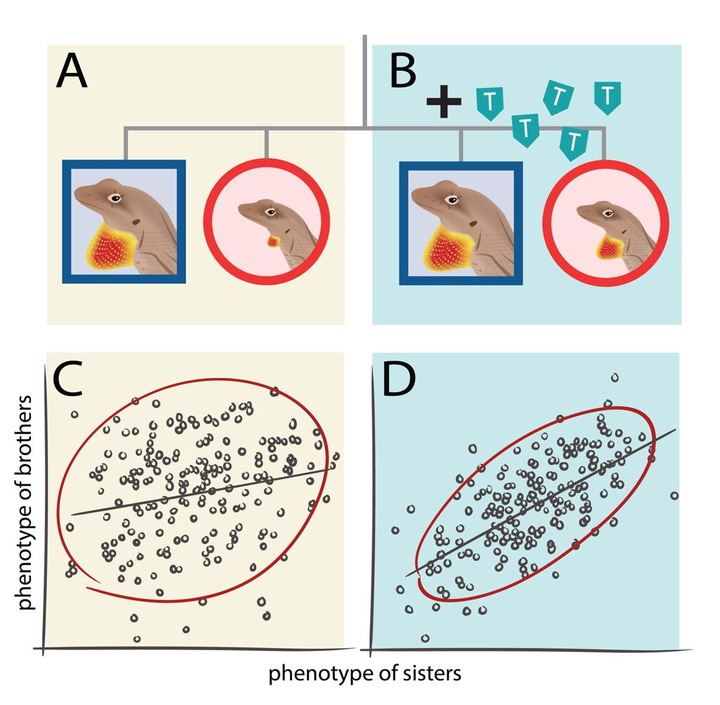
 Figure 5 (by Jacelyn Shu)
Abstract
For more than a billion years, anisogamy has set the stage for sexual dimorphism, driving the evolution of distinct male and female phenotypes from the same genome. There has been a longstanding emphasis on the constraints imposed by shared genetic architecture, framing the evolution of the sexes largely in terms of sexual conflict. Yet the remarkable extent and diversity of sexual dimorphism illustrates that evolution repeatedly produces a wide range of discrete phenotypes within species, demonstrating constraints on the evolution of dimorphism may often be transient and thus difficult to detect at the genomic level. Here, we synthesize insights from quantitative genetics, genomics, and experimental evolution to examine how readily genomes generate and maintain sex-specific variation. We review evidence that regulatory mechanisms can evolve rapidly using existing sex-specific architectures and that many traits already exhibit partially decoupled genetic architectures even when sexually monomorphic. We evaluate attempts to identify genomic signatures of constraint, discuss limitations of current theoretical models, and consider what is known about the tempo and repeatability of sexual dimorphism across lineages. Together, these findings highlight the evolutionarily flexibility of genomes, and the many mechanisms by which evolution navigates the restrictions of genomic constraints to allow for sex-specific adaptation.

Wouter van der Bijl
Research Associate
I study the evolution of complex traits, such as color patterns, brains and behavior. To that end, I use sequencing, quantative genetics, and large data approaches.